Language Exchange vs Language Classes
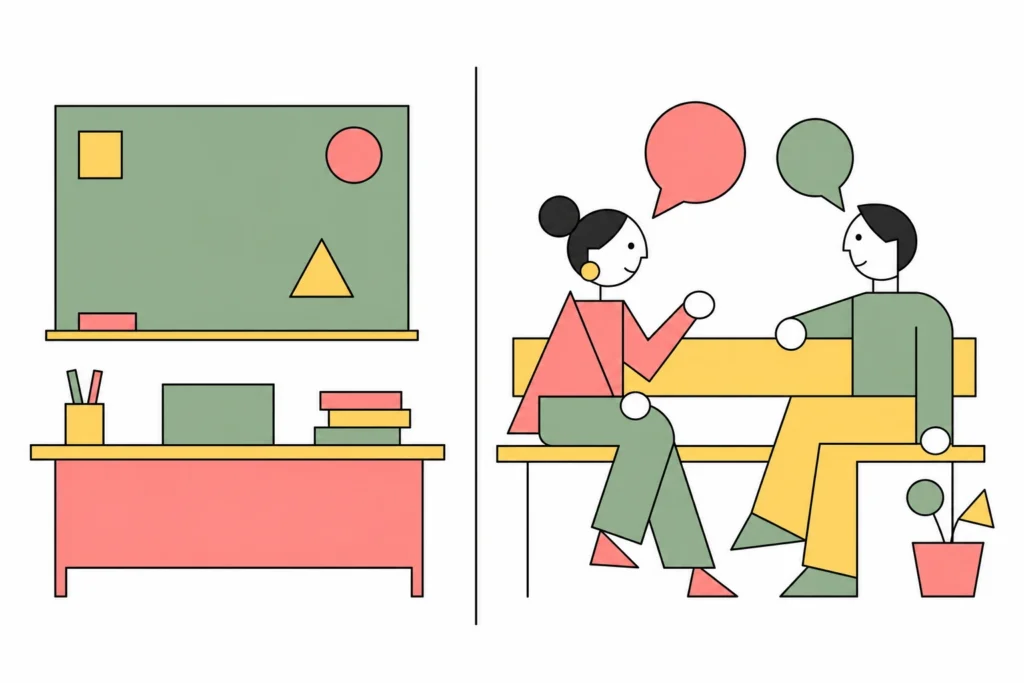
Should you join a class or find a language exchange partner? It is the most common question new learners ask, and the honest answer is that the two do different jobs. Understanding the difference helps you spend your time — and money — where it counts.
What Classes Do Well
A structured class gives you three things that are hard to get elsewhere: a syllabus that introduces grammar in a sensible order, a teacher who can explain why something is wrong, and a schedule that keeps you accountable. For absolute beginners, that scaffolding is genuinely useful — it is difficult to have a conversation when you have no words yet.
What Language Exchange Does Well
An exchange gives you the one thing a class struggles to provide: unlimited, unscripted speaking practice with a patient native speaker. It is also free, flexible, and rich in the cultural detail that textbooks flatten out. Because both people are learners, the fear of speaking fades quickly. Our guide to the tandem method explains how a well-run exchange turns conversation into real practice.
The Case for Doing Both
Most successful learners do not choose. They use a class or an app to build the foundation, then use a language partner to put it to work in conversation. The class supplies the grammar; the exchange supplies the fluency. If a formal class is out of reach, a free community program plus a good grammar book covers much of the same ground.
How to Decide Right Now
If you cannot yet form simple sentences, start with a class, an app, or a structured book. Once you can string together basic thoughts, add an exchange immediately — waiting until you feel “ready” to speak is the most common way learners stall. The sooner you are in real conversations, the sooner the rest of your study starts to pay off.
Classes and exchanges are not rivals. They are two halves of the same process, and the learners who progress fastest tend to run both at once.
When a Class Is the Better Choice
For all the strengths of language exchange, there are moments when a structured class is simply the smarter investment. Absolute beginners with no vocabulary at all often struggle to make an exchange productive, because conversation needs raw material to work with; a few weeks of class or app study first gives them enough to actually talk. Learners preparing for a specific exam benefit from a teacher who knows the format and can drill weak points systematically. And anyone working to a hard deadline — a move abroad, a job requirement — may need the pace and accountability that a paid class enforces.
A class also provides something an exchange cannot: authoritative answers. When you genuinely do not understand why a construction works the way it does, a trained teacher can explain it, whereas a native-speaker partner often knows the right answer without being able to say why. Recognising when you need explanation rather than practice is part of learning efficiently.
Combining Both Without Overspending
The good news is that you rarely have to choose one and abandon the other, and doing both need not be expensive. A common, affordable pattern is to use a low-cost app or a library course for the structured grammar foundation, then layer a free language exchange partner on top for the speaking practice that apps cannot provide. The class-style resource answers your “why” questions; the partner gives you the hours of real conversation that turn knowledge into fluency.
In a city like Vancouver, where free community programs and no-cost partner exchanges are plentiful, the paid portion of your learning can be small or even zero. Reserve spending for the moments a class genuinely adds value — exam season, a plateau you cannot break, a deadline — and lean on the free exchange ecosystem for everything else.
Frequently Asked Questions
Should a complete beginner start with a class or an exchange?
Usually a little structured study first — an app, a book, or a class — to build basic vocabulary, then add an exchange as soon as you can form simple sentences. Do not wait until you feel “ready” to speak.
Can a language exchange fully replace a class?
For speaking and confidence, largely yes. For systematic grammar and exam technique, a class or good self-study resource still helps. Most fluent learners used both.
Is an exchange enough to pass a language exam?
It builds the speaking and listening side well, but exams also test reading, writing and specific formats. Pair an exchange with targeted exam practice for the best result.
How do I afford both a class and an exchange?
Keep the paid part minimal: a cheap app or free library course for structure, plus a free community program or partner for practice. In Vancouver the exchange side can cost nothing.